

A few weeks ago I got this DM.
Unbeknownst to the sender, it outlined the Pilates industry’s biggest problem.
“Hi! I saw your post on W2 and 1099 instructors and I had some questions! Trying to keep this short, but I am a 1099 instructor at a small studio, this is the first studio I’ve ever taught at, so while I keep being told things are ‘industry standard’ I don’t actually know.
We are required to fill our classes, but if we have less than the class minimum of 3, we don’t get paid to teach. If we cancel the class, it’s held against us during our yearly review. If classes are not maintaining minimum, we can also be removed from them (even after teaching them for a year, and have no issue with minimums until summer hit).
We are also required to vacuum and mop the studio and do not get paid for this time as well.
It would be great to get some insight on if this is truly what is expected in the Pilates world or not!”
My reply got so long Instagram flagged it for being too long. Turns out DMs have a word count limit. Who knew?
You know the part that really got me? It was the last line. “Is this truly what is expected in the pilates world or not.”
She had no idea. And why would she? This is definitely not covered in most teacher trainings.
Nobody sits you down and explains what you’re actually owed, legally, for the hour before class starts and the twenty minutes after it ends.
But understanding this stuff clearly is what will save Instructors from leaving the industry.
So let’s actually answer her question: “Is this truly what is expected in the pilates world or not?”
The problem that is threatening to destroy the Pilates' industry
A few months ago, I couldn’t tell you with confidence which classification I legally am.
Not because it’s THAT hard, but because no body had ever explained it to me before. So for a long time I thought, well, it must not be that important.

But it is important, and I’ll give you proof: if any of these stories sound like you - you’ll want to pay attention.
One instructor at Pilates Loft in VA wrote that she’s expected to “take out trash, do front desk duties like customer transactions and merch sales all within 5 minutes between classes.”
An instructor at CorePower in IL said corporate “expects teachers to do tasks — front desk and cleaning — that they should be hiring people to do.”
At Club Pilates in NC, finding your own substitute isn’t optional help, it’s your job: “it’s our responsibility to find them, or the class gets cancelled.”
One instructor at Fly Fitness Studio in UT is expected to market the business herself — “advertise every week” — with no additional pay for it.
At Beyond Pilates in TX, there’s a non-compete clause blocking instructors from teaching another Pilates-adjacent class within 20 miles.
These stories are important because they are so common. Most instructors I know have stories like these.
However, stories like these should belong to W2 employees. Yet most instructors I know are 1099 contractors.
This mismatch - being paid like contractors, yet treated like employees - is one of the biggest problems facing the Pilates industry today.
As a result of this mismatch, instructors are under paid and over worked. Burnout is rampant. Instructors are leaving the industry left and right. And it’s jeopardizing the future of our industry.
So let’s get into. We’ll be going over your top questions like;
W2 vs 1099: WTF does it even mean??
Why a Pilates Instructor should care about the way they’re labeled
Who decides my label? Isn’t this up to the studio? Do I even have a choice?
If I am mislabeled, is it actually worth doing anything about?
W2 vs 1099: WTF does it even mean?
These are legal classifications that determine your tax treatment. Every Pilates Instructor (in the US) is either a 1099 Contractor, or a W2 employee.
Let’s use a little analogy to make these words make sense.
Imagine a hair salon - let’s call it Paige’s Pony’s (lol).
Missy, a W2 stylist, is a salon employee at Paige’s Pony’s. The salon owner, Paige, sets Missy’s schedule, provides her with the chair and product, tells her the pricing menu, and takes taxes out of her paycheck automatically. Missy is part of Paige’s business.
Lucy, a 1099 stylist, is renting a chair from Paige’s Pony’s. Lucy pays the salon a fee to use their space, but she sets her own hours, brings her own products, and sets her own prices. Lucy is on the hook for her own taxes at year end. Lucy has her own business, it just happens to operate inside Paige’s Pony’s.
The parallel to Pilates: if a studio is dictating your hours, requiring their class format, providing all the equipment, controlling your rates, you’re a W2. If you’re setting your own hours, bringing your own approach to how you teach, using your own equipment or paying to rent theirs, and setting your own rates, you’re a 1099.
Some states have their own overrides (CA for example would say all Instructors are W2, regardless of the arrangement) but generally, this is how the classification works.
Now, let’s go back to Susie’s DM and see what she’d be classified as, based on the nature of her work at the studio.
unpacking the DM, piece by piece
As a reminder, let me reshare the DM that started this article. We’re going to breakdown each of the characteristics of her employment, and match them with a W2 or 1099 status.
The DM:
“Hi! I saw your post on W2 and 1099 instructors and I had some questions! Trying to keep this short, but I am a 1099 instructor at a small studio, this is the first studio I’ve ever taught at, so while I keep being told things are ‘industry standard’ I don’t actually know.
We are required to fill our classes, but if we have less than the class minimum of 3, we don’t get paid to teach. If we cancel the class, it’s held against us during our yearly review. If classes are not maintaining minimum, we can also be removed from them (even after teaching them for a year, and have no issue with minimums until summer hit).
We are also required to vacuum and mop the studio and do not get paid for this time as well.
It would be great to get some insight on if this is truly what is expected in the Pilates world or not!”
Let’s break it down.
“If we have less than the class minimum of 3, we don’t get paid to teach.” This one feels unfair. If you’re a 1099, it is actually to be expected.
There’s an actual New York court case on this exact fact pattern — Yoga Vida NYC, Inc. v. Commissioner of Labor (2016) — where the NY Court of Appeals found that yoga instructors who were only paid when enough students showed up were still legitimately contractors, because sharing that financial risk is a normal feature of an independent-contractor relationship, not a red flag.
“If we cancel the class, it’s held against us during our yearly review.” Sounds like W2.
A “yearly review” with real consequences is the kind of ongoing performance management you’d expect from an employer (vs if you were a 1099 independent contractor).
“We can also be removed from them [classes].” Sounds like W2.
This leans employee. Real contractors generally control their own book of business; having a manager make the call to remove you from your own class based on performance metrics looks a lot more like being managed than being contracted.
“We are also required to vacuum and mop the studio and do not get paid for this time.” Really giving W2 here.
This is the strongest one in her message. Mandatory, unpaid, non-teaching labor, assigned by the studio (i.e. not chosen by her), is exactly the kind of “off the clock” work that’s driven real lawsuits in the industry.
Put together: Susie’s situation isn’t a clean, obvious case in either direction. Which is a very realistic portrayal of how MOST instructors are treated and feel about their classification. It’s part of what makes this all so confusing
OK, now that we know the basic characteristics of W2 and 1099, let’s talk about question 2, aka, why you should even care about this!
Your wallet is begging you to pay attention
So, why, if you’re a Pilates Instructor, should you care about this?
If you’re anything like me, you’ve avoided thinking about this because… well, there are a million other things to think about. And frankly, employment classification labels seems pretty boring.
BUT! If this statement pisses you off, keep reading: your paycheck is smaller than it SHOULD be if your studio is incorrectly calling you a 1099.
Let’s do some quick math:
Let’s say you teach 3 classes a week and get paid $45 per class. That means you’re grossing $135/week. $7,020 per year.
This is where your label matters:
W2: $6,483 net pay
1099: $6,028 net pay
Difference: $455 - w2’s literally making almost $500 more for the same amount of work!
Again: we’re talking about doing LITERALLY the same amount of work. The only thing that changes here is how your studio classifies you. Them classifying you as 1099 costs you nearly $500 every year. But this isn’t the only reason it sucks.
It sucks double because:
them labeling you as 1099 reduces how much money you take home (as we’ve just established).
they’re most likely not giving you the benefits that make the income reduction potentially worth it.
Hate to break it to you gf, but if you’re paid as a 1099, it looks you’re getting screwed twice: they’re controlling you like you’re a W2, but paying you like a 1099. Lose/lose.
what your unpaid hours are actually worth
Another thing to consider: we all know the amount of work that goes into teaching one 45 minute class far exceeds said 45 minutes.
Did you know that if you were a W2 employee, you’d get paid for that work?
If you want to know how you could earn $100+ more per week, just by logging the work you’re ALREADY DOING (!!!), make sure to subscribe below to keep reading! We’ll also be getting into whether 1099 or W2 is best for you based on your own individual preferences and goals and what the exact steps are that you can take if you’d like to reverse your 1099 misclassification. I promise I’m going to make all this super easy for you :)
The premise:
As W2, the studio is legally required to pay at least minimum wage for all your compensable hours.
As 1099, there’s no minimum. Whatever your agreed upon fee is, that’s what you’re going to earn for you work required to deliver that service. 1099’s aren’t protected by minimum wage requirements.
Let’s look at what would happen if all your hours were paid, as they would be under W2 status.
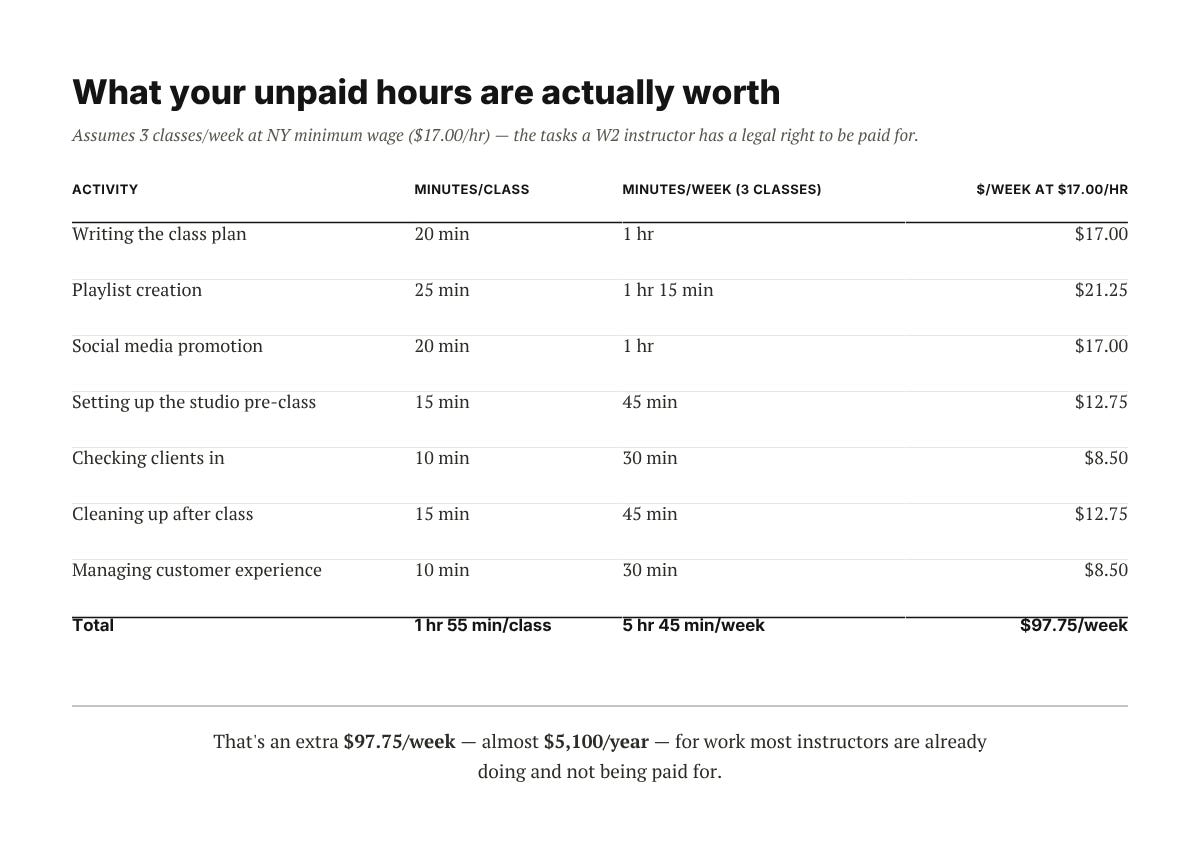
Almost $5,100 a year in increased pay — for work most instructors are already doing and simply not being paid for.
Sit with that for a minute.
$5,100 more per yer - for doing the work you are ALREADY DOING!!
OK, so my paycheck is taking a hit. Any other reasons I should care?
In addition to getting a smaller paycheck, here are a few other REAL, MEANINGFUL reasons you might want to pay attention to your classification:
Job loss or reduced hours. As W2, if your studio cuts your hours or lets you go, unemployment insurance is there. As true 1099, it isn’t (unless you were actually misclassified, and filed an unemployment claim)
Injury or pregnancy. Get hurt teaching as W2 and workers’ comp exists. Get hurt as 1099 and you’re on your own. There’s no coverage unless you bought your own. Same logic applies to paid family leave, which most states (New York included) reserve for employees only.
Write-offs. This one actually favors 1099s. As a 1099, you can deduct business expenses — mileage, equipment, even your health insurance premiums — that a W2 employee can’t touch.
All of this, influenced by a decision your studio makes when they hire you.
okay, but Paige. Do I even have a choice here?!
Is this even up to me? I mean you literally just said, this is all determined by what the studio decides when they hire me.
True. However…
You have much more power than you realize.
The studios decision to call you a 1099 isn’t actually binding.
The IRS, DOL, or a state agency - they get the final call.
These people test the real relationship. They don’t care what a studio wrote down on a piece of paper about you, they care about the nature of your work. AKA how you’re treated.
And getting them to weigh in on your situation?
It is much easier than you’d expect.
But before we get into all THAT, let’s figure out what you’d actually prefer to be labeled as. Because there are a few important details we haven’t talked about yet.
If it were up to you, which would you choose?
Start by asking yourself these questions. Count up how many A’s you select versus B’s.
Is this your main income or a side income?
Side income, other income covers the gaps
Main or near-main income
Do you want to teach at multiple studios?
Yes, and I want that freedom protected
Not really, I’d rather have one steady home base
Could you absorb a surprise tax bill without stress?
Yes, I have savings/a partner’s income/a buffer
No, I need taxes handled for me
How would an injury or 6 weeks off affect you?
I’d be okay, I have other income or savings
I’d be in real trouble
Do you want to control your own schedule, method, and clients?
Yes, strongly
Not particularly, I like structure
How do you feel about paperwork and filing your taxes?
Fine with it, or I have a good CPA
I’d rather it just be handled automatically
Do write-offs (mileage, gear, home studio space) matter to your finances?
Yes, meaningfully
Not really a factor for me
Mostly A’s? You probably do want genuine 1099 status — which means the real work is making sure your actual working relationship supports it (more on that below).
Mostly right column? You’d likely be better served by W2, even if you’re currently paid 1099 — which means it’s worth knowing whether you already qualify for it, whether you asked for it or not.
Either answer is legitimate. What’s not legitimate is a studio deciding for you, in either direction, without you ever getting a real say.
OK. let’s get a few things straight.
So far, we’ve talked about:
The impacts of 1099 vs W2 on your paycheck
Basic characteristics of either status (remember the Paige’s Pony’s example?)
How instructors are often treated like W2 employees, even if they’re paid like 1099 contractors, plus, what this looks like in practice
Who actually has say on your classification
Now, let’s talk about:
How the classification is actually legally determined
What steps you can take to challenge your classification if you feel you’ve been mislabeled
How the classification is actually legally determined
There are three tests that actually decide your 1099 vs W2 status. And fun fact? These tests don’t care what you or your studio says you are.
I’ll say this part again: your classification isn’t up to the preference of your studio. (Or even you, frankly.)
Your classification is the output of a legal test that gets determined when an Instructor files for unemployment, files a wage complaint, or a state agency runs an audit.
At that point, the agency asks one question: how did the Instructor/Studio relationship actually function?
There are three tests that aim to answer this question, and they’re used differently by each state. Because nothing can be simple here!
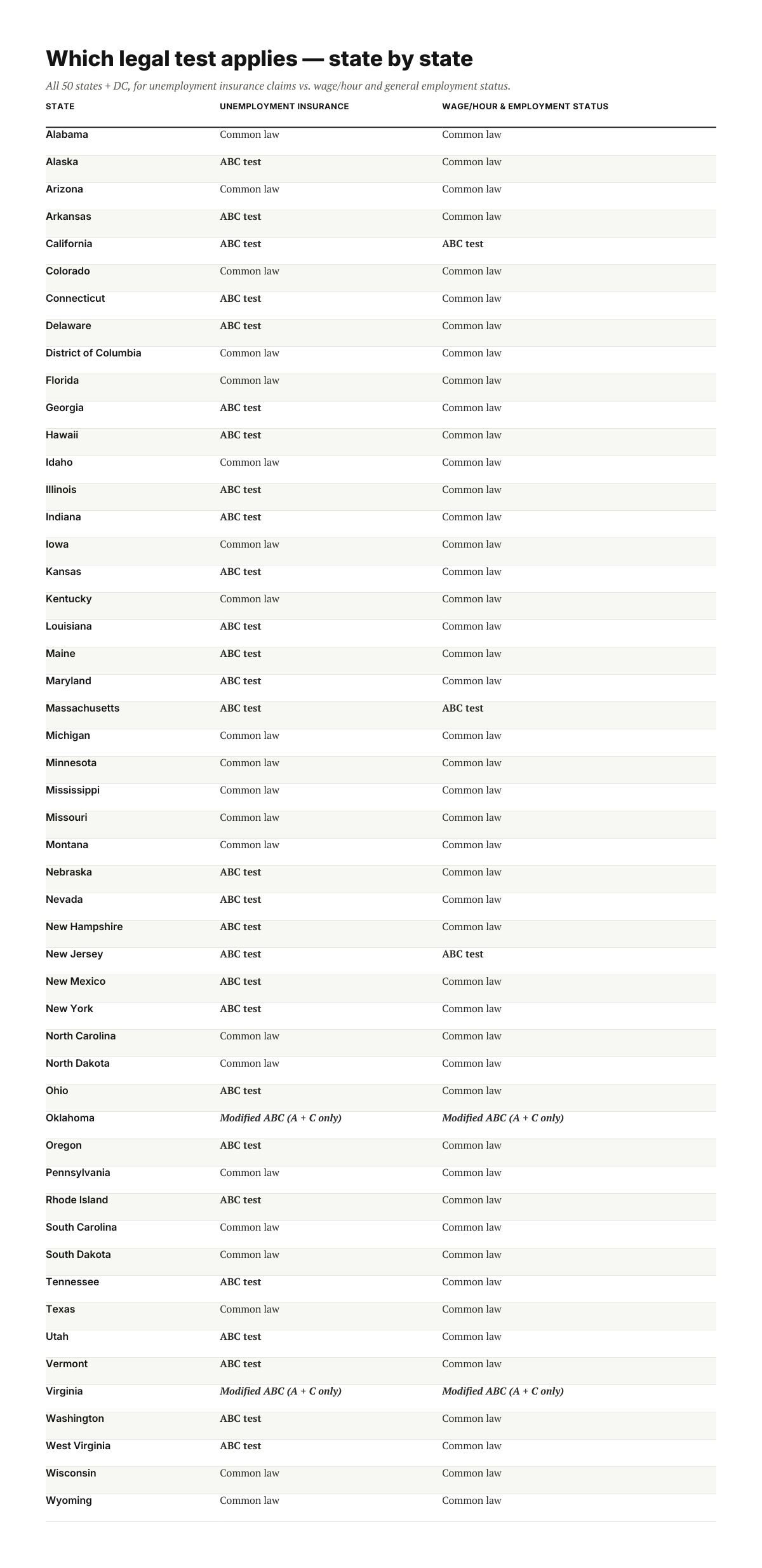
Note: at the bottom of this post, you will find a state by state guide that shows which tests each state is using to determine classification.
The determining tests you need to know about
The IRS common-law test. Looks at behavioral control (does the business control how you do the work), financial control, and the nature of the relationship. This is the default federal test for tax purposes.
The DOL economic reality test. Asks whether you’re economically dependent on the business (W2 employee) or genuinely running your own operation (1099 contractor) — weighing things like your opportunity for profit or loss, your investment in the work, how permanent the relationship is, and how central your work is to the business itself.
Worth knowing this one has been politically unstable — a 2024 rule made it harder to classify workers as contractors, and the current administration has been working to roll that back toward older, more employer-friendly standards. It’s genuinely in flux right now.
The ABC test. Used by 30+ states for wage law generally, and used by a handful of states for unemployment insurance.
It presumes you’re an employee unless the business can prove all three of: (A) you’re free from their control, (B) your work falls outside their usual business, and (C) you run your own independently established trade.
Prong B is the hardest one for a studio to contest: a Pilates instructor teaching at a Pilates studio is doing exactly what the studio’s business is.
Said another way, according to the ABC Test, if you teach Pilates at a Pilates studio, you’re an employee. Aka a W2 Employee, not a 1099 contractor.
if you’re in New York (or one of roughly half the states)
New York uses the common-law control test for most things — wage claims, overtime — but switches to the ABC test specifically for unemployment insurance. That’s a meaningful nuance, because it means the test that applies to you can literally change depending on why your classification is being questioned.
Here’s the sharpest way to put it: if you filed for unemployment today, there’s roughly a 50%* chance you’re in a state that would find you should have been classified as an employee — regardless of what your 1099 paperwork says.
*That “roughly half” figure is specifically about states applying the ABC test for unemployment insurance claims (New York among them) — it is not a claim that half the country would rule in your favor on every legal question. Only three states (California, Massachusetts, New Jersey) apply ABC that broadly. The rest of the “half,” New York included, apply it narrowly to unemployment specifically.
Here’s where I need to check in with you guys. This stuff is pretty dense. Take a deep breath, we’re almost there.
Soon you will know what your options actually are if you just realized you’ve been getting screwed.
So, what can we do if we’re misclassified?
Here’s the breakdown of your options, organized by amount of effort required.
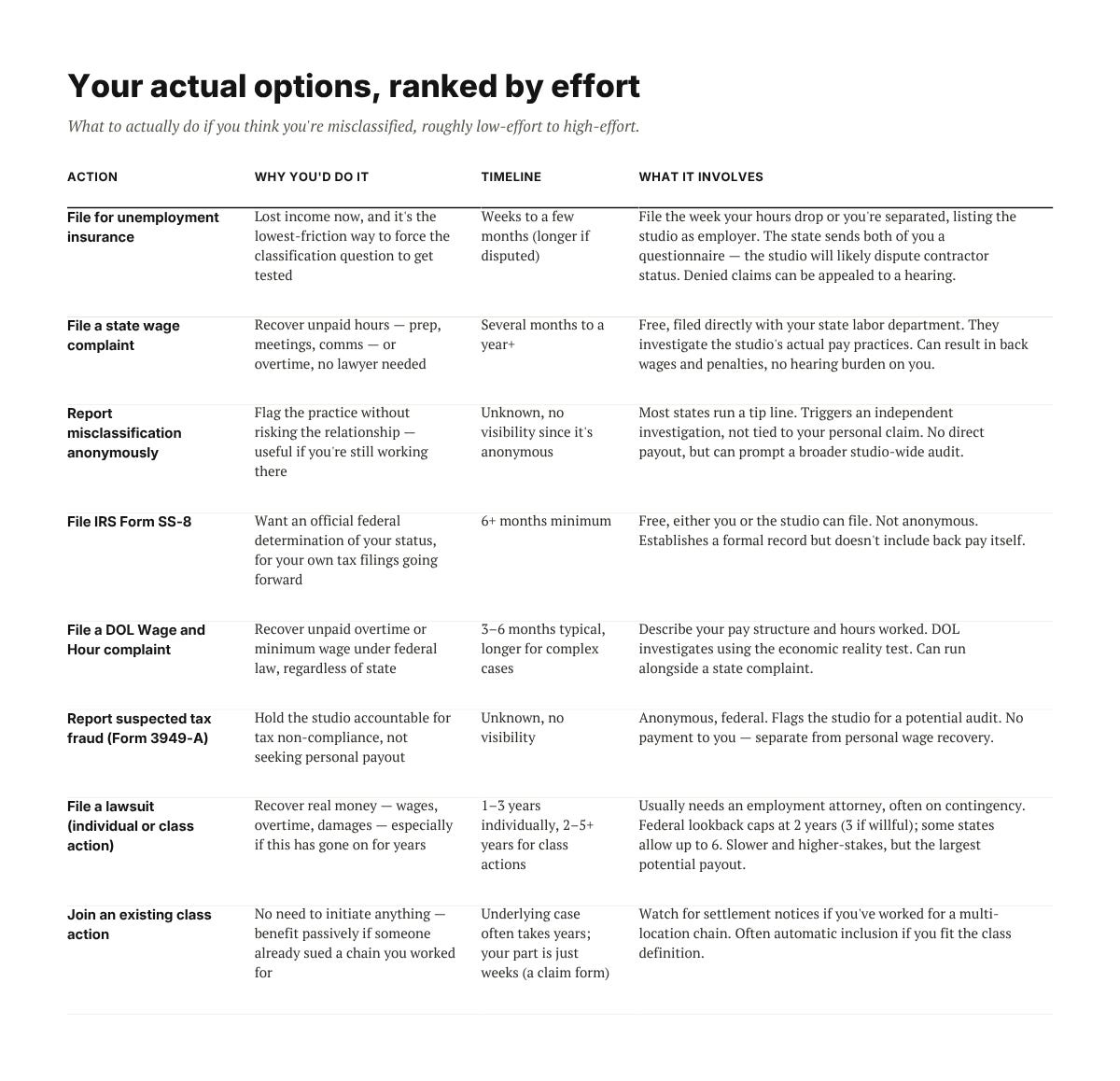
what to actually do with all of this
If you read the decision framework and landed mostly in the W2 column, but you’re currently paid 1099: the first move isn’t a lawsuit. It’s honestly assessing your day-to-day reality against the tests above, and picking the lowest-effort action from the table that matches your situation.
If you landed mostly in the 1099 column and you want to stay that way: the move is making sure your actual working relationship supports it. Ask for your own schedule. Teach elsewhere. Opt out of team meetings and performance review sessions. The label only holds up if the reality behind it does too. But remember, if you’re in CA, MA or, you’re pretty much guaranteed to be W2. It doesn’t matter what your working relationship looks like, and that goes back to Prong B being so impossible to fail.
What’s next?
And if you’re genuinely not sure which column you’re in — that’s normal, and it’s exactly why I built the Studio Salary Database in the first place, and exactly why I started the paid “is this normal?” community here on Substack. You don’t have to sort through your specific situation alone or guess whether what your studio told you is actually true. Compare notes with instructors who’ve already been through it. We’re all in this together.
Xx, Paige
State by State guide to Employment Tests:
Wow, this is incredibly informative and useful! The admin side of being a pilates instructor takes up a huge amount of mental load and trying to determine what's "normal" often becomes a taboo thing to question. Thank you for transparently and factually bringing light to this topic and empowering instructors to do what's best for them!